
The Battle to Save the Entertainment Capital of the World
By Mac Flanagan
CHAPTER I - Suspense outside City Hall
“Who the hell would oppose this?"
That was the question echoing outside the walls of Los Angeles City Hall on Feb.17. It was the frustration of hundreds of “below-the-line” film and television workers spilling over. These individuals aren’t the movie stars and directors; they’re the camera assistants, grips, writers, makeup artists, boom operators, visual effects artists and editors that make the industry tick behind the scenes. They stood in a line that wrapped around the block of Main and Temple streets, waiting for hours just to get a few minutes in front of a microphone inside. They were there to discuss “Keep Hollywood Home," a series of motions designed to make it easier to shoot film and television within city limits.
Currently, the local film industry in Los Angeles is in a freefall, and statistics from FilmLA, the nonprofit that tracks and manages local production, are disheartening: feature film production is down 31.7% over the past five years, while commercials have fallen 35.3%. But perhaps most alarming is television production, which has tanked a whopping 50.1%. Overall, production in the city fell another 16% in 2025 alone, dropping to just 19,694 shoot days. Between 2022 and 2024, California lost an estimated 42,000 film and TV jobs, according to Bureau of Labor Statistics data.
The crisis is not the result of any single event (though industry insiders say the COVID-19 pandemic and 2023 industry strikes did play a role). Instead, it is the result of years of mounting failures: costs that have made Los Angeles one of the most expensive places on earth to shoot, incentive programs that arrived far later than rivals (and which still struggle to compete with other markets), and a tangled mess of permits, fees, and red tape that has made shooting here excessively difficult. The people feeling the brunt of this collapse aren’t the studio executives or the red carpet A-listers. They are the camera operators, makeup artists, sound mixers, grips, and multitude of other production and post-production specialists who comprise the main workforce of Hollywood.
Editor Piper Kroeze, who has worked on series like the thriller You, knows exactly what that looks like. She broke into the industry in 2010 and earned her first union job two years later.
“Since then, I had never been unwillingly out of work," she said. Then COVID hit. After stepping down temporarily to assistant editing work when the pandemic caused production to dry up, a network television job carried her through most of the 2023 WGA and SAG-AFTRA strikes. But when that show was cancelled in 2024, the landscape had changed.
“I have been fortunate to edit a couple of documentaries during this slow time,” Kroeze said. “But they do not pay my usual rate and are not steady work. I have also lost my health insurance because of the lack of union jobs available.”
Costs are a big factor. Studios are able to make the same content at a discounted rate in out-of-state markets, potentially saving millions of dollars in the process. Cities and regions attract film production primarily by the strength of their tax incentive programs. Simply put, these are discounts production companies receive from governments in return for shooting and developing content locally. Georgia offers a highly competitive uncapped 20% credit, while New York has developed a sprawling 30% rebate, according to their official websites. Both are among the most attractive in the U.S.
“Ultimately it is purely financial,” Tim Scanlan, a producer who has worked on shows like Smallville and the Quantum Leap reboot,said. “Production companies want to get the most bang for their buck.”
Scanlan says he’s currently working on a television pilot that has done almost everything in New York. According to him, the aggressive tax incentives and rebates there dropped the total costs to about 40% lower than California’s projected price tag.
Domestically, Georgia and New York have siphoned production away from L.A., their market shares increasing while L.A. has lost ground, according to a FilmLA study. Internationally, markets like London and Vancouver have become film boom towns, each with their own aggressive tax incentive program. London boasts a 34% base credit, which can be expanded up to a ludicrous 53% for independent films, according to the British Film Institute.
“It makes it a no-brainer to do the work there,” Scanlan said.
It was against the backdrop of a global race for production dollars that L.A. was clearly losing, that hundreds of industry workers showed up to City Hall on Feb. 17, ready to demand that something be done about it. The stakes were high. Various motions were on the table, ranging from permit streamlining, fee cuts, and fast-tracking approval for soundstage facilities – all aimed at making it easier and faster to shoot in L.A.
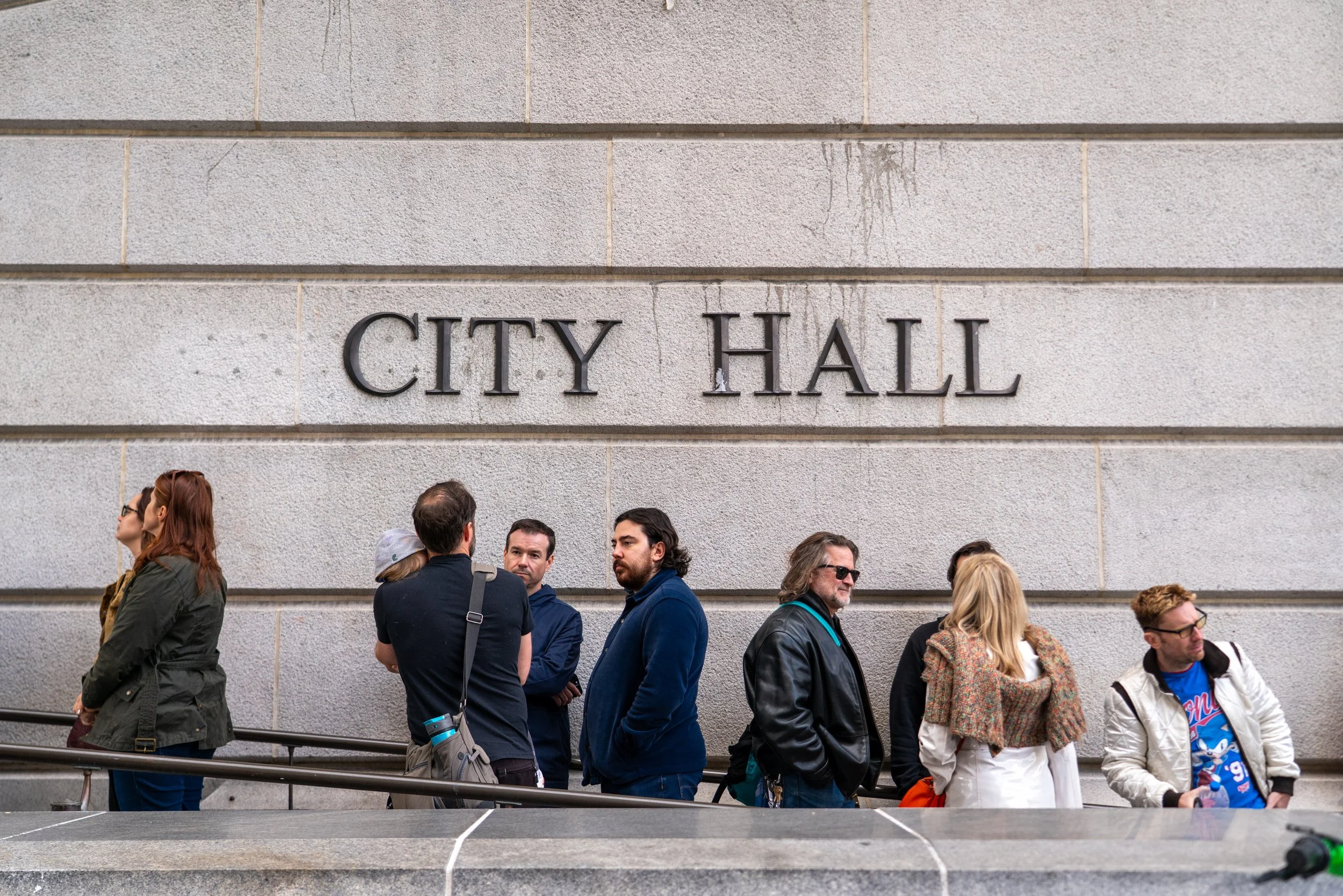
Film industry workers wait in line outside Los Angeles City Hall for a chance to participate in a public comment session for the “Keep Hollywood Home” motions. Photo: Mac Flanagan
As rain began to drizzle on the sidewalk, word began to filter through the crowd that stakeholders and executives who were lobbying against the measures were gaining access to the hearing room over ordinary workers, complicating what most felt would be a common-sense process.
Cale Thomas, a makeup artist and a legislative lead for Stay In LA, a nonprofit that has spearheaded the local effort for film-related policy reform, noticed.
“They just let government affairs people and stakeholders that don't work in the film industry in there that have nothing, nothing to lose. Or nothing to do with the film industry, or production for that matter,” he said. “The city council members were letting their friends upstairs.”
While standing outside, Thomas noticed an industry member waiting in the rain with a baby in his arms, unable to enter. He pulled aside some of the stakeholders who had made it into the hearing room and brought it up. They told him there was nothing they could do about who was inside, but he pushed back.
“You can be an example,” he said, “by getting up yourself and allowing a man holding a baby standing in the rain to come and sit down.” To him, it was that simple.
“If you're not understanding that basic component of humanity or basic citizenship, then I don't know what to do,” Thomas said.
In the end, the public comment session ended with over 100 crew members still standing outside, unable to make their voices heard at the podium. But the day ended with a significant win. The panel passed seven motions (with some stipulations) giving a boost to the #KeepHollywoodHome community.
Los Angeles Television releases by year
Chapter II: Bad News for Baywatch
In early 2025, the production company behind the Baywatch reboot made a choice that would have been almost unthinkable 20 years ago: they nearly took the show, an American television classic synonymous with the sunny beaches of Los Angeles, to shoot in Australia. The story of what happened next became a chapter in the broader conversation about Hollywood’s crisis, and a case study in everything that has gone wrong with making film and television content in the entertainment capital of the world.
Brian Ralston, a Los Angeles-based composer who has scored projects like the sports drama Crooked Arrows and instructs at UCLA Extension, followed the ordeal closely. The production company, he said, had been actively persuaded to bring the show home.
“[The city] fought really hard to shoot here. They got their permits to shoot in Venice Beach,” he recalled.
FilmLA and city officials like Mayor Karen Bass made the case that Baywatch belonged on L.A.'s beaches. The company producing the show agreed, secured the permits and prepared to enter production.
Then the day of the shoot arrived.
Ralston said city authorities came out and informed the production that they were breaching various codes and restrictions. “They came out and [said], you can’t bring those trucks onto the beach. You can’t put those things there. You can’t shoot after 5 p.m.,” he said.
The production, which had been lured back to Los Angeles with the assurances it would work, now found itself unable to undertake the basics of a television series on the beach it was named for.
“The production felt really like a bait and switch,” Ralston said. “Like, you told us this was going to be easy: ‘Come back, we’ll work with you.’ And now you’re telling us we can’t do the things we need to do to shoot this thing,”
For Thomas, the Baywatch debacle was not a surprise, it was the result of problems he and others had been red-flagging for over a year.
“You should be able to shoot on the beach in Venice. I don’t care,” he said. “You should be able to shoot a hot lifeguard running down the beach in slow-mo. And you can’t do that. You literally cannot do that.”
The obstacles were the product of overlapping jurisdictions: the city, the county, and the California Coastal Commission all converge on Venice Beach. Thomas said Stay In LA had flagged the beaches and harbors permitting problem to city officials more than a year before the Baywatch crisis. The response they received was “Oh, the tax incentive will fix it, the tax incentive will fix it, the tax incentive will fix it,” Thomas said.
“There were hundreds of productions that faced the same exact thing [as Baywatch], and those producers decided to go to Sydney, Vancouver, London, Budapest. They figured out the problem, which was to not shoot here.”
“If you can’t make it cheaper, just make it easier. [Currently] you’re not doing either. Now it’s super expensive and it’s super hard to shoot here.”
According to FilmLA’s recent scripted content study, only 157 film, television, and streaming projects shot in Los Angeles County were completed and released in 2024, down from 228 just two years earlier. In TV alone, L.A. productions dropped from 105 to 77 in a single year, while the United Kingdom added 17 projects in the same period.
Baywatch nearly joined the exodus.
A last-minute intervention by Mayor Karen Bass, who reportedly stepped in to bring studio, city, and county
members together to coordinate a fix, kept the shoot in Los Angeles. But Ralston was clear about what the episode indicated.
“It’s the hassle. No one wants to deal with the hassle,” he said. “So that’s just another reason I don’t think it proved that production can come back here at the end of the day. It proved that it’s just a hassle.”
Part of what made the Baywatch situation so representative of L.A.’s broader production woes, Thomas argued, was that the city had almost no safeguards in place to fix it when things went sideways. Productions hitting permit snags previously had nowhere to turn: FilmLA, as the permitting agency, maintained it was the city’s problem; meanwhile the city departments deflected responsibility between themselves.
Only after Stay In LA and other advocates showed up to a Board of Public Works hearing (an event typically reserved for discussions about asphalt and streetlights) did the mayor’s office finally appoint a film liaison.
The appointment was telling in its own way, though: a single person, working part-time, for a region that Thomas noted is home to more people than the entire state of Georgia. Meanwhile, the competitor markets of Sydney, Vancouver, and London each staff their film offices with dozens of dedicated personnel.
“If you can’t make it cheaper, just make it easier,” Thomas said. “[Currently] you’re not doing either. Now it’s super expensive and it’s super hard to shoot here.”
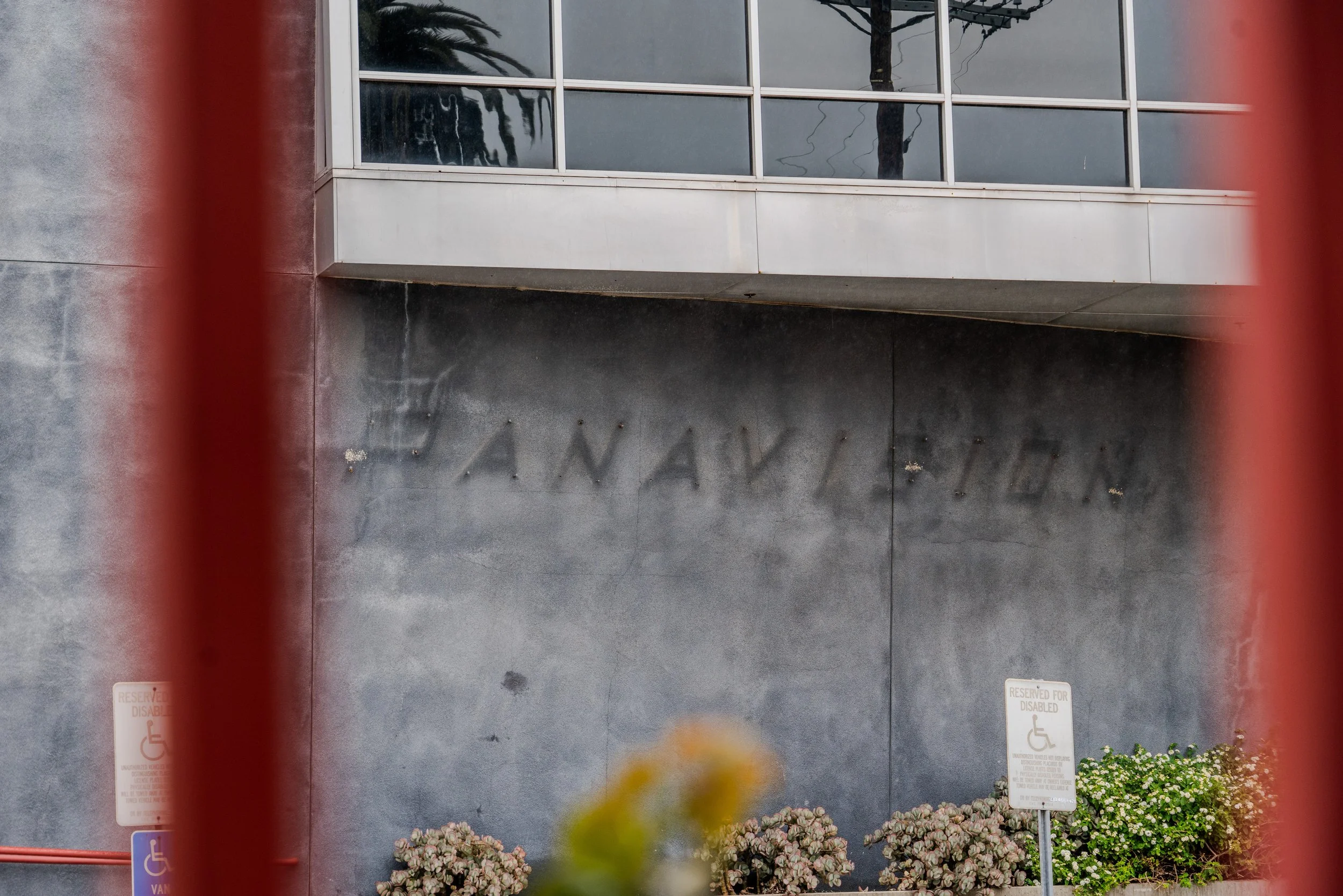
Panavision, a cinema camera and lens supplier, operated an iconic facility on Seward Street in Hollywood for decades. In April 2025, the location shuttered, a manifestation of the shrinking physical footprint of Los Angeles’ film industry. Photo: Mac Flanagan
Chapter III: Help on the way?
In July 2025, California rolled out Program 4.0, the latest iteration of the state's Film and Television Tax Credit. It expanded the annual allocation of funding for film and TV credits from $330 million to $750 million, totaling $3.75 billion over five years. The program offers a base 20% credit for feature films and new television series, a 35% rate for independent films, and a headline-grabbing 40% for television series relocating to California from other states, according to the California Film Commission, the state agency that oversees the program. It’s California's most serious bid yet to compete with rival markets. The question, though, is whether it came in time, and whether it’s enough.
Philip Sokoloski, vice president of Integrated Communications for FilmLA, said that 135 projects have qualified for aid under the new program since last July, and the first of those approved by the California Film Commission are now at work in the state, many of them in Los Angeles.
“We are getting more phone calls," Sokoloski said. "We are seeing impacts on the production data now." A quarterly report expected within weeks, he said, should show the program beginning to register in the data.
The lag between the new program’s start date last summer and its visible results was allegedly built into its structure. Productions approved last August had until February of this year to be in production, meaning visible impacts on shoot day numbers were not expected until 2026.
“Whereas all the way through the end of last year, we weren't really able to point to any evidence of those projects being there in terms of shoot days,” Sokoloski said. That evidence is just now beginning to arrive, according to him.
At the city level, the seven initial "Keep Hollywood Home" motions that passed this spring are part of the same broader effort to meaningfully compete. Sokoloski stated that FilmLA had already begun work on some key initiatives before the motions formally passed, including a review of the more than 60 sets of special filming conditions across neighborhoods in the City of Los Angeles alone. Working in conjunction with the Los Angeles Police Department, FilmLA has already “retired” about a quarter of those often restrictive conditions.
“Do these rules still make sense for the L.A. of today?” Sokoloski noted. “That's something we're looking at very closely.”
For Pamala Buzick Kim, an entrepreneur, creative producer, and co-lead of Stay In LA, the city-level reforms are essential, but their value depends on how they are implemented.
“Program 4.0 is active but still rolling out,” she said. “The city's reforms passed but aren't implemented yet. That's where we're
“We may not always be the cheapest, but we have to at least be the easiest.”
hitting the next block.” She highlighted staffing shortages and a lack of urgency within city departments as the main obstacles.
“They don't move fast unless leadership makes them,” she said. “That's where the mayor and elected officials have to put their foot on the pedal.”
Buzick Kim is also skeptical that any single effort will be sufficient on its own.
“Neither is enough,” she said in reference to Program 4.0 and the city reforms. “You need state, county, local, and honestly federal [participation]. These have to stack and compound for L.A. to be in a competitive conversation at all.”
Stay In LA’s focus is on local permitting, the red tape that gave Baywatch problems on Venice Beach and that Buzick Kim says has been driving production away for years.
“We may not always be the cheapest,” she said, “but we have to at least be the easiest.”
CA Tax credit 4.0
$300M
$75M
$112.5M
$262.5M
Even $750 million may not be enough. While Sokoloski called the program “among the most generous” at its current funding level, he said many in the industry feel it still falls short. Unlike programs in Georgia and other rival markets, California's incentive does not allow for above-the-line spending, like salaries for directors and actors, from qualifying. TV commercials are also excluded. Sokoloski noted that over 20 other competitors have programs to support commercial production that California lacks.
Finally, California operates a capped incentive program, meaning it can allocate only a fixed amount of tax credits to productions each year, while other markets such as Georgia and the U.K. run uncapped programs without a statewide annual limit on incentives.
Meanwhile, these gaps are what a separate piece of legislation is aiming to close for the post-production sector.
Marielle Abaunza, president of the California Post Alliance, a nonprofit that advocates for post-production-friendly policy on the state level, is one of the driving forces behind AB 2319, a proposed bill that would create California's first explicit post-production tax incentive, entirely independent from where a project shoots. Under Program 4.0, productions must shoot in California to qualify for credits. AB 2319 would change that, providing incentives to any production that brings at least 75% of its post-production work back to the Golden State.
“Projects have stopped coming back to California for their finish,” Abaunza said. “This tax incentive is designed to reclaim those projects.” She has watched the decline of post-production in Los Angeles over more than a decade in the industry.
“All the vendors in sound are fighting for the same five projects,” she said. “Your only way to compete is through budgets, and then it becomes a race to the bottom.”
The bill has moved with notable speed. It passed the Arts Committee with a bipartisan 8-0 vote and cleared the Revenue and Taxation Committee 6-1. The final major hurdle is expected in early May in the Appropriations Committee, with floor votes to follow before it hopefully reaches Governor Newsom's desk in the fall.
According to Abaunza, time is of the essence. With elections approaching, California is heading into a transition period that could make or break the chance for new legislation for the entertainment industry.
“My message to Governor Newsom is, ‘you got us this far,’” she said. “Please finish the job before you leave office.”
What Program 4.0, the city's permitting reforms, and AB 2319 all share is that none of them has fully delivered yet: the incentive is still rolling out, the reforms are passed but not implemented, and the post-production bill hasn’t made it out of Sacramento.
Meanwhile, the competitor markets continue to steam ahead. And as Sokoloski noted, television production in Los Angeles, which collapsed more than any other category, is unlikely to fully recover even if everything goes perfectly, simply because the streaming boom that drove it has ended.
“We know we're in a fight for every one of these projects we can get back here,” he said. “We won't reach those numbers again anytime soon, unfortunately.”
For those on the ground, this is more than just abstract data and bar charts, though. It’s cancelled shows, a lost safety net, and the uncertainty of when and where the next job will be.
“Below-the-line is rooted here,” Buzick Kim said. “When production leaves L.A., it hollows out the local crew base, because you can't just pick up and go shoot in Georgia,”
“Film isn’t just culture here,” said Ben Urquhart, a post-production specialist who was waiting in line outside City Hall that rainy day. “It’s middle-class jobs, it’s small businesses, and a statewide ecosystem of craftspeople who depend on consistent production and have the infrastructure and labor force that are ready to execute. It's foolish to give this work and labor away,” he said.
For Kroeze, the numbers aren't abstract either. She's still waiting for the next union job. The documentaries help, but they don't pay her rate and they don't come with health insurance.
"There are hardly any jobs," she said. Whether the incentives, the reforms, and the legislation arrive in time to change that is the question Los Angeles has yet to answer.
Helpful References:
FilmLA Production Data: Rising California Film & TV Tax Credit Productions Signal Growing Industry Momentum Amid 2025 Production Losses
California Film Commission Program Guidelines 4.0: 4.0 Program Guidelines
AB 2319 language: AB 2319: Personal Income Tax Law: Corporation Tax Law: credits: qualified motion picture: postproduction. | Digital Democracy
Header Image: Downtowngal, CC BY-SA 3.0 <https://creativecommons.org/licenses/by-sa/3.0>, via Wikimedia Commons